
Monthly Archives: April 2015
Listening Cherry 09 - Michael Swan - receptive pronunciation
 | Listening Cherries is a blog where I talk about listening issues - from classroom activities to academic research. Listening Cherry no. 9 discusses Michael Swan's use of the term 'receptive pronunciation'. |
Image from here.
Michael Swan is a revered figure in the field of English Language Teaching. But he can also be very forthright in his opinions, and so two years ago, it was with some trepidation that I saw that he had quoted a review of mine of Robin Walker’s Teaching the Pronunciation of English as a Lingua Franca (Cauldwell, 2012). But ‘Phew!’ I wasn’t a target, it was simply a quotation to start off a discussion. This is what he quoted:
I have a (probably naive) hope that we can have a single model of speech which can encompass/capture both (a) pedgogic advice for maximal clarity and intelligibility in pronunciation on the one hand, and (b) the speeds, reductions, disfluencies and lack of clarity of spontaneous speech for listening on the other hand.
He then suggests that some languages - such as Japanese - the relationship between the slow clear style of speaking and speeded up speech is a manageable one - the word he uses is ‘hospitable’. But he goes on to say
French, on the other hand, is awful. At high speed it sheds unstressed schwa vowels all over the place, ending up with consonant clusters that make Russian looks soft and cuddly: ce que je ferais > /skʃfre/. English, too, is down toward the unfriendly end of the scale.
And he goes on to argue that the non-core items which are not needed for production, are needed for what he terms ‘receptive pronunciation’
for receptive pronunciation the productive priorities are pretty much reversed - it is precisely the so-called ‘non-core’ elements that may have the greatest importance for teaching.
I think the term ‘receptive pronunciation’ is an interesting one: it encapsulates very strongly, it seems to me, the idea that the teaching of listening and pronunciation can be thought of as a unified, integrated enterprise. (I’ll return to this point in a future posting).
However, his argument seems to move towards the idea of separation (‘priorities are pretty much reversed’), that we should be looking at different outcomes for pronunciation and listening - he seems very largely accepting of the ELF core items for pronunciation, but he really wants to include the non-core items for the teaching of listening.
I have been wrestling with the nature of the relationship between listening and pronunciation for many years (c.f Cauldwell, 2003), and I am continuing to do so. So, more on this next time.
Cauldwell, R. (2011). [Review of] Teaching the Pronunciation of English as a Lingua Franca. [Robin Walker, OUP] Speak Out! 45, pp. 24-25
Cauldwell, R. (2003). The two-sides rule in teaching listening and pronunciation. [Online article] Developing Teachers here
Swan, M. (2012) Grammar and Pronunciation. Speak Out, 47, pp. 21-23.
Listening Cherry 08 - Bamboozled by ‘idle mass’
| Listening Cherries is a blog where I talk about listening issues - from classroom activities to academic research. Listening Cherry no. 8 discusses an audio extract from Mark Hancock and Annie McDonald's 'Authentic Listening'. |

Mark Hancock and Annie McDonald’s ‘Authentic Listening’ has wonderful recordings, the majority of them from local radio stations from around the UK - they include recordings from Insight Radio, Radio Teesdale, and Desi Radio (west London’s Punjabi community radio station). There are also videos - specially recorded ‘vox pop’ and discussions, and videos from TED-talk like events from FameLab, where young people give short presentations on science and technology. A fantastic collection of recordings, multi-accented.
In Lesson 10, the second of the nine Pronunciation for listeners lessons, there is a focus on what Mark and Annie call ‘crowded syllables’, which in my work I refer to rather less technically as a ‘mush’, or ‘squeeze zones’. The image below is taken from page 27, and the learner’s task is to write in the words that occur in the gaps between the prominent syllables. All twelve of the audio extracts are of authentic speech from the recordings. And I want to focus on item no. 6, because I couldn’t do it.
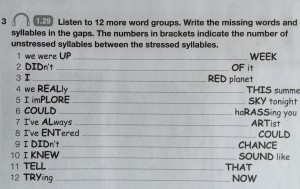
I had the wonderful experience of doing this exercise, as if I were a learner, without (of course) prior knowledge of what the words were. AND I COULDN’T DO IT. I was really stumped. Have a listen, what do you think is being said?
I discuss this further, and give the ‘answer’ on this page here.
Listening Cherry 07 - Authentic Listening
| Listening Cherries is a blog where I talk about listening issues - from classroom activities to academic research. Listening Cherry no. 7 raves about a recent publication from Mark Hancock and Annie McDonald. |
There is so much to like and admire about Authentic Listening Resource Pack, the latest offering from Mark Hancock and Annie McDonald. Some facts first:
- Authentic Listening Resource Pack
- 144 pages, A4 size, two data CDs with audio, one DVD-video
- 45 two-page units, scripts for all the recordings, and an answer key
- The pages of the book are photocopiable
- Recordings come from radio programmes, videos of popular lectures
- ‘Vox pop’ and ‘informal discussion’ videos made for this publication
- The 45 units have 4 or 5 sections
- Each section has up to 15 activities/tasks per recording (but normally 12)
- Tasks ‘are achievable’ for students around the B1/B2 level
So as you can guess from this list this is an amazing publication, just in terms of the amount of work that has gone into producing it.
But what I most like about it is that there is a substantial focus on the nature of the sound substance of spontaneous speech. This can be seen and heard most obviously in the ‘Tuning in’ tasks which occur in most units, and in the nine ‘Pronunciation for Listening’ units, which are placed so that they occur every fifth unit. These units use micro-listening and audio-concordancing techniques to teach learners the true nature of spontaneous speech. Here’s a rough guide to the first three ‘Pronunciation for Listening’ units.
- unit 5 - thinking time noises ‘um’, and stretched words (what I call ‘stepping stones’ in Phonology for Listening), and repetitions
- unit 10 - ‘crowded syllables’ (what I call ‘squeeze zones’) where words are mushed up together between prominent syllables
- unit 15 - rushed adverbs ‘actually’, plus ‘sort of’ ‘kind of’ and ‘just’
These ‘Pronunciation for Listening’ units use carefully selected extracts from the recordings - very short, often repeated a few times, and sometimes slowed down (awesome!). They really help teachers and students get ‘up close and personal’ with the sound substance of speech. There’s something to teach, something to learn.
Lastly, Mark has been for a long time an expert at using inventive spellings both to represent the distorted sounds which are very common in connected speech, and to help with exercises which help learners learn the realities of everyday speech. I love this example from unit 40: ‘jeck’n’ for ‘do you reckon’.
Brilliant stuff. A wonderful demonstration of the fact that, in the listening class, there is plenty to teach, and plenty to learn, about the sound substance of speech.
Next blog-post, I’ll focus on a short recording from Authentic Listening.
Listening Cherry 06 - An impending revolution?
| Listening Cherries is a blog where I talk about listening issues - from classroom activities to academic research. Listening Cherry no. 6 describes an impending revolution in speech perception research. |
In my last blog here I reported feeling uneasy about the nature of research in speech perception, and in particular its use of a model/assumption known as ‘the phoneme input assumption’ (Magnuson et al., 2013).
But I feel even more uneasy because I am open to the criticisms of this type: ‘You have no right to comment! You are cherry-picking the literature, and do not understand the whole picture.’
But interestingly, major figures in the field seem to be similarly - well not uneasy exactly - but aware that a change of approach (a paradigm shift in models) is required in their field. For example, Mirjam Ernestus (Ernestus, 2014) concludes that no model of speech perception is sufficiently developed ‘to obtain detailed insight in the human language capacity’ (p. 17).
Even more strongly, Magnuson et al (2013) argue that the field of research into speech perception is both on the verge of, and in need of, a revolution. In their view, research is at a tipping point where the ‘temporary simplifying assumptions’ that the field has made in order to do research have now become obstacles - ‘complicating assumptions’ (Magnuson et al, 2013, p. 433).
They criticise certain aspects of the current models and state that researchers are:
constructing a pretend signal, rather than grappling with actual speech. Without tackling the signal, we will not know what helpful constraints we have hidden with the abstractions of our simplifying assumptions (p. 22).
The more I read this, the more I am horrified. ‘WHAT? You have been constructing a PRETEND SIGNAL for all these years? And you are NOT grappling with ACTUAL SPEECH????’
But I tell myself I should be grateful that this research is turning toward ‘actual speech’ and that it should (I hope) generate research findings which we can apply to language description, teacher training, and most of all into improving the teaching of listening.
Magnuson et al. go on to identify four ‘avenues as most promising for pushing the field beyond the tipping point and to new theoretical frameworks’ these are:
- the need to grapple with the speech signal itself,
- integration of the study of spoken word recognition with descriptively higher levels of language processing,
- the need for theories and models to grapple with learning across the life span, including language development in childhood and rapid, flexible learning in adults, and
- the need to respect neurobiological contraints on mechanisms for language processing. (p. 435/p. 23)
That looks to be a great agenda.
Ernestus, M. (2014). Acoustic reduction and the roles of abstractions and exemplars in speech processing. Lingua, 142, 27-41.
Magnuson, J. S., Mirman, D., & Myers, E. (2013). Spoken Word Recognition.The Oxford Handbook of Cognitive Psychology, 412.
