
Monthly Archives: March 2016
Listening Cherry 18 - Larkin’s line survives the plethora
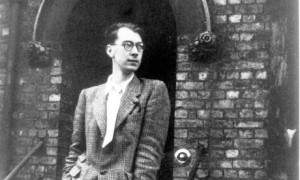
Image from here.
This post follows on from Listening Cherry 17. It continues to consider, guided by Sir Christopher Ricks’s commentary, the intonation of the final line of Philip Larkin’s poem An Arundel Tomb.
What will survive of us is love.
Ricks writes:
… If you were to stress both ‘survive’ and ‘us’, the line would not survive the plethora; and if you were to stress neither, the line would not survive the inanition. (277)
When I read a piece of literary criticism like this I feel as happy as a cat having its tummy tickled. I purr with pleasure at the fine language and the skilled use of rare words (plethora/inanition) - which, crucially, I understand. I feel pleased with myself that the distant edges of my knowledge of vocabulary was tested and I did OK!
But hang on, I think he means something here. Oh yes, he is saying that if you stress both ‘survive’ and ‘us’ the line will be overloaded and will die.
I know it’s unfair, and I know it’s not done with this type of literary criticism (we should just lie back and purr) … but what if we were to treat this statement as a testable hypothesis? (Criminally prosaic, perhaps - but fun). We could listen to the two recordings which Larkin himself made which had something close the plethoric pattern that Ricks says is unsurvivable, and see what we think of them.
Here’s one.
Here’s the second.
Hmm. Both these readings give the line four prominences:
|| WHAT will surVIVE of US || is LOVE ||
And I think the line survives very well. But to be fair, maybe what Ricks means is not ‘stress’ but tonic placement, and he is would have the line spoken with ‘survive’ and ‘us’ as tonic in separate speech units:
And I believe that the line survives. ELT sometimes commits the same error: we discuss with great precision the significance of an intonational phenomenon without taking into account the other intonational phenomena that are going on around it. And we certainly believe the pronouncements of great men and women in our field, without evaluating what they say by listening to evidence (it would be so disrespectful to do so!).
And just before I go, here is the inanition version - I attempt to give a prominence-free version:
(You have to imagine that I preceded the line with the words ‘but I didn’t say’, giving us a double prominence speech unit with a long non-prominent tail:
|| but i DIDn’t SAY what will survive of us is love ||
And I believe that Ricks is right about that one! It is diabolically inanitious*.
Ricks, C. (1984). The Force of Poetry. Oxford: Oxford University Press.
Listening Cherry 17 - What will survive of us is love
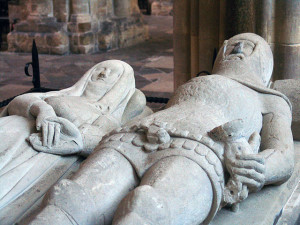 Image from here
One of Philip Larkin’s most famous poems is ‘An Arundel Tomb’. It is a poem about the tomb in Chichester Cathedral which you can see in the image. The key thing to notice is that the two figures have their hands joined. Here is the last stanza.
Time has transfigured them into
Untruth. The stone fidelity
They hardly meant has come to be
Their final blazon, and to prove
Our almost-instinct almost true:
What will survive of us is love.
Sir Christopher Ricks, the famous literary critic, writes about the intonation of last line of this poem:
… Larkin’s last line has at least two different possibilities of intonation. If you lay more weight on ‘survive’, you hear a classical asseveration - ‘What will survive of us is love’. Classical because what is meant by the less stressed ‘us’, taken in passing, is humanity at large, the largest community of all men and women; classical because of the transcending of individuality within commonality.
For the purposes of our discussion, I imagine him to be discussing an reading which we can render as
|| WHAT will surVIVE of us || is LOVE ||
Ricks does not mention stresses (prominences) on ‘what’ or ‘love’, his focus is on the non-prominent ‘us’ which for him has ‘classical asseveration/humanity at large/transcending of individuality within commonality’ meaning.
Here is one of Larkin’s recordings of the last line, which matches (more or less) Ricks’s imagined reading.
Can you hear the ‘classical asseveration/humanity at large/transcending of individuality within commonality’ in the non-prominent ‘us’?
Ricks imagines another reading with prominent/tonic ‘us’.
This would be the weight of romantic apprehension; ‘us’ not of the unstressed and properly undifferentiated mankind but as a particular ‘us’, here and now, moved not just personally but individually, particular visitors to a tomb or particular contemplators of one such visitor. (Ricks, 1984, p. 276)
For the purposes of our discussion, I imagine him to be discussing an reading which we can render as
|| WHAT will survive of US || is LOVE ||
Again, Ricks does not mention stresses (prominences) on ‘what’ or ‘love’, his focus is on the prominent ‘us’ which for him has ‘romantic apprehension/particular ‘us’/moved individually’ meaning.
Here is another of Larkin’s recordings of the last line, which matches (more or less) Ricks’s imagined reading.
What is interesting for me is the weight of meaning that Ricks places on the presence or absence of stress on ‘us’. It is a brilliant piece of practical criticism of the type: ‘I respond to literature, with rare words and beautiful sentences of my own’. Having done an English Literature degree (albeit having no idea what I was doing) I marvel at the skilled deployment of rare words, and the rhythm of sentence constructions. But jeepers, he is placing a lot of significance - way more than I would ever dare (or hope, or have the ability) to do on a relatively simple intonational difference.
Fortunately (or not) we have recorded evidence from Larkin himself. He recorded the poem three times (at least) and on two occasions he made ‘us’ prominent and tonic, and on one occasion it is non prominent. And after admiring the baroque prose and flights of fancy of Ricks’s interpretation, I find the recordings somewhat deflating.
Listening to them. I find it difficult to justify attributing quite so much (or indeed any) difference in meaning to the presence or absence of prominence on ‘us’. Part of me thinks that in the context of the poem (the world of the persona as observer contemplating and thinking aloud to himself the significance of the tomb) it seems to make little difference in meaning. Particularly because this five-word speech unit is but one component of what Larkin refers to as a ‘big finish’ - which concludes with the two words ‘is love’.
But of course there is another context to consider - that of a poem being read aloud where Larkin as reader is addressing an actual or imagined audience. Non-prominent ‘us’ could be viewed as signifying a large group ‘people in general’ whereas prominent ‘us’ would mean the smaller group of ‘you and me and the other listeners to this reading/recording’. I could go further with this analysis, but Ricks (above) has done it much better than I could ever do.
But fundamentally, I believe that these different intonational renderings are simply different ways that mean the same thing. We can attribute meanings to these (prominent/non-prominent) formal differences through a process of inspection and imaginative play - but my view is that such meanings are unwarranted interpretational impositions. And it is something we also do in ELT: I believe we impose unwarranted layers of interpretation when we inspect a piece of written language - masquerading as speech - and set our imaginary forces to work to explain the meanings of intonational differences. But most often, in everyday speech, contextual conditions are such that formal differences carry no differences in meaning.
Ricks, C. (1984). The Force of Poetry. Oxford: Oxford University Press.
