
Monthly Archives: November 2016
Listening Cherry 32 - The black box
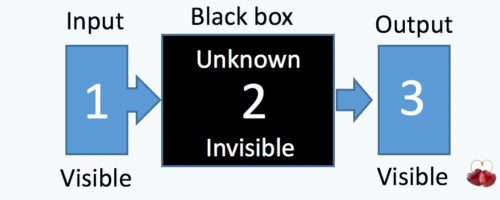
We still behave, as a profession, as if the secrets of learning to listen are hidden inside a black box whose mechanisms are unknowable and unteachable. Two things inside the black box seem particularly unknowable and un-teachable: (a) the messy, unruly sound substance of normal everyday speech and (b) knowledge of what our students make of this sound substance. Because we ‘don’t know’ what goes on in this black box we focus almost all our efforts on what happens before and after the black box. We focus on the input and the output.
We strive very hard to make the input authentic, useful and appropriate - matching topics, vocabulary, context, and characters in a way that will motivate learners and facilitate transition to work on other parts of the syllabus.
We also strive hard to make the output appropriate: making the tasks that the students have to do while/after listening valid acts of meaning and communication.
We put extraordinary focus on the input and output, relying on the power of contextual meaning and contextual appropriacy to skip over the problems and challenges of the black box processes. We seem content to let the black box continue to be impenetrable and intractable.
But hang on, is that fair? Don’t we give students strategies to take with them while they are engaged inside the black box? Indeed we do. Before they enter the black box, we get them into a good learner frame of mind (focussed on the task, feeling good about themselves as learners) and we exhort them to apply good behaviours (don’t strive to hear every word, listen for the stresses, build meanings, re-evaluate and reconsider). We then exhort them to apply these behaviours when they go through the black box. And after they have been through the black box we focus on their performance of these good behaviours.
But this is still about input and output - it’s like giving people warm clothes and motivating talks before they go for a walk through an unlit mine - they have to navigate without a light, at speed, and afterwards report what they sensed in the mine (they couldn’t see anything, remember). And they have to report on the state of their clothes, whether they stayed warm, and whether they still felt good about themselves after the walk. So the preparation before and the report after are more concerned with the mine walkers self-management strategies, rather than on the nature of the mine. So it is with listening classes. We are expert at the before and after, but largely inexpert in our knowledge of the sound substance of speech. We do the before and afters very well - but we avoid the sound substance, with our focus on the peripheral (worthy, useful, but still peripheral) rather than on the central issues.
This idea of listening as a black box comes from Michael Rost, writing fifteen years ago, who wrote:
Listening is still often considered a mysterious “black box” for which the best approach seems to be ‘more practice’. Much work needs to be done to modernise the teaching of listening. (Rost, 2001: 13)
Personally, I am wholly against the idea that the best approach to listening is the ‘more practice’. If you are interested in modernising the teaching of listening, keep following this blog. You can also attend a workshop I am giving in April 2017 in London at the London Language Lab here. You can buy my Phonology for Listening: Teaching the Stream of Speech here, or wait for my Syllabus for Listening: Bottom-up approach - due late 2017.
Rost, M. (2001). Listening. In R. Carter & D. Nunan (Eds). The Cambridge Guide to Teaching English to Speakers of Other Languages. Cambridge: Cambridge University Press.
Listening Cherry 31 - Thinking warm
One of the problems with our current approach to teaching listening is that we can overdo/dose on the preparatory and post-listening activities. And we thereby run the risk of stealing time away from direct encounters with the sound substance of speech which is contained in the recordings.
It is like spending most of the time of a swimming lesson outside the pool, having long preparation and post-swim talks which deal with:
- Security of belongings
- Lifeguards and first aid
- Being safe - no jumping
- Following health procedures - foot bath, hair wash before entering the pool
- Warming up activities
- [Swim]
- Showering
- Drying
- Dressing
- Feedback
- Filling in evaluation forms for the pool administration
And rather than teaching them to swim, we give them things to think about while in the water which will make them good controllers of their own metabolism, as they move from the warmth of their clothes, to the cold of the pool, and back again.
Yes, it will feel cold, but how are you feeling at the moment in your everyday clothes? Warm, good. So while you are swimming, I want you to remember how you feel right now, in warm clothes. I want you to ‘think warm’ throughout the whole swim. You will feel a whole lot better about swimming when you think warm - you almost won’t notice the cold.
Image from here.
Listening Cherry 30 - Waterfall listening
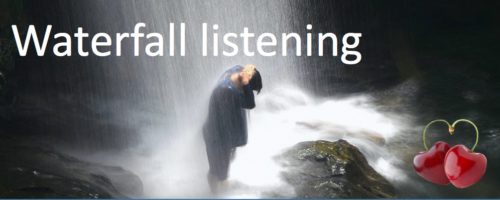
Some listening lessons are like standing under a waterfall - you centre the student under the main flow of the water so that it is directed at the centre of their head. Sometimes the flow of water is a gentle trickle and they wonder what the value of standing there is. Suddenly torrents hit them hard on the head and cascade down over the shoulders and becomes a force under which it is difficult to stand. The student moves to one side and looks up as if to reprimand the waterfall and is surprised by a new, differently-angled cascade that catches them full in the face. They take in mouthfuls of water, and are blinded by dollops of water catching them in the eyes which they have to rub to clear them. In doing so they lose balance and stagger, and a new harder cascade catches the top of their swimming costume, and hands come off the eyes onto the swimming costume to prevent it slipping. The student is flustered, embarrassed, temporarily blinded, coughing and spluttering water.
And the teacher asks ‘Did you see the way the sunlight caught the stream of water and made a rainbow out of the fine spray?’
Image from here.
This was, of course, a strategy-free lesson.
