
Monthly Archives: January 2017
35 - Travelling without a map
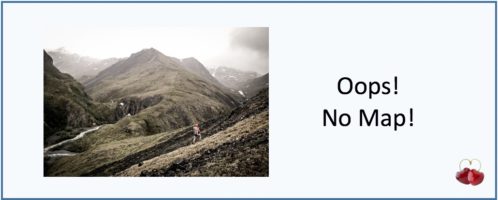
The way we teach listening is like insisting that travellers arrive at a destination via several stops without giving them the means of travelling.
It’s like asking people to move from point to point with a map that has geographical features (hills, valleys, rivers) but with the roads tracks and trails missing. You may want them to be able to identify Mount Big Meaning, but not allow for the fact that they may find themselves in a tunnel when the moment for identification comes. You may want them to identify Castle Tikbox, without allowing for the fact that they are wholly focussed on crossing a wild river - jumping from stone to stone - without losing their balance.
We need to describe the whole journey, teach the means, teach the patterns of the stream of speech the roads, the trails, the footpaths. We need to focus far more on the relationship between sound substance and its interpretation (decoding, meaning building).
What we currently do is pretend our learners can travel meaningfully, without giving them the means of navigating through the stream of the sound substance. We keep them in ignorance of the sound substance (because we teachers are ourselves ignorant) and therefore deny learners the means of learning how to navigate.
Image from here.
Listening Cherry 34 - Aping the goal
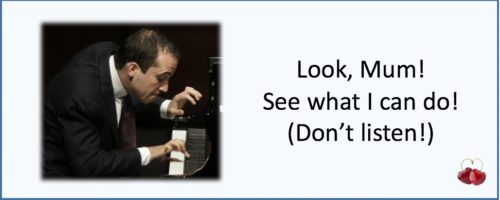
Imagine a concert pianist, on stage playing a virtuoso sonata by Liszt. Wonderful patterns of notes a beautiful and moving (in all senses) soundscape of colours, major and minor keys, cascades, soft then loud, etc. etc. This is a public display of expertise which is a wonder to behold. Expert behaviour, hard earned and hard learned over a long period of time.
But what if someone claiming to be a teacher decided to teach pupils such expert behaviour, by focussing on the visible observable aspects of performance. Their pupils would be encouraged to sit at a piano and splash away at the keys, imitating the observable rapid movement of the fingers, the coordination of the hands, and the foot movements on the pedals. All without learning the means of playing the piano, disciplined controlled slow movements, simple scales, starting with easy pieces. The result may look enchanting an accurate depiction of what it takes to be a famous pianist - but the sound would be awful. All without paying attention to the sound.
This would be a case of aping the goal (where ‘ape’ means ‘to imitate someone or something, especially in an absurd or unthinking way’) at the cost of dealing with the major issue of sound.
In many approaches to listening comprehension exercises we ape the behaviour that is the goal, while minimising the amount of detailed instruction that provide the means towards this goal - increasing students’ mastery of the sound substance. We are thus goal-obsessed, and we starve our learners of the means of achieving the goal.
We expect learners to role-play native speaker/expert listener behaviour in listening comprehension lessons by catching meanings. But we don’t teach them how to perceive words in the sound substance of speech.
We get them to ape the goal behaviour (the describable elements of it) without giving them the means (the dimension of sound) whereby the full goal behaviour can be achieved.
The belief seems to be that through undergoing repeated listening comprehension exercises of this type, learners will eventually learn how to perceive words in the sound substance. It is as if we are leaving the undescribable (or what we believe to be the undescribable) to work its magic on the learners perception unconsciously while we focus attention on what we can describe.
Image from here. Oh, and Igor Levit, who is pictured is a wonderful pianist who produces the most gorgeous sounds.
Listening Cherry 33 - Selective reality
We like to think that making listening as real-life as possible is the best way to teach listening. But our use of ‘reality’ in the design of lessons materials is selective. We steer our lessons as close as we dare to real-life listening, and we focus on extracting meaning but we remain in denial about the realities of the sound substance.
We keep the number of listenings as close as possible to one, because - the argument goes - in real life we only get one chance. We make the learners listen as though they are present and active at the interaction that has been recorded. And we fill their minds with contextual information about the people, the situation, the purpose and predictions about what will be said. We plug learners into a reality role. We plug them in to a mind set and situation.
The problem is that the more we steer closer to these realities at the level of meaning, the less time there is to focus on the realities of the sound substance of speech - the normal messiness of everyday speech. The urge to mimic reality leads us to forget that the classroom is a place for teaching and learning, and that (pretty much) anything goes as long as learning is effective.
But it’s nobody’s fault. ELT simply does not (yet) have a model of speech which encompasses the messiness and wildness of everyday speech (as I have said frequently in this blog the ‘rules of connected speech’ are wholly inadequate). The only model of speech that exists in ELT is the Careful Speech Model - optimised for clear, intelligible pronunciation.
In the absence of a model of spontaneous speech (optimised for listening), the requirement to mimic reality is convenient for us, because it takes up a lot of time and it enables us to feel we are doing a good job as teachers and materials writers. Because ‘that is the way good teachers teach listening’ - we conform to the expected behaviour. The trouble is we are ignoring the realities of everyday normal speech.
We are in denial about the realities of everyday speech. To adapt the words of a famous Calvin and Hobbes cartoon ‘It’s not denial, we’re just very selective about the reality we accept’.
Image from here.
